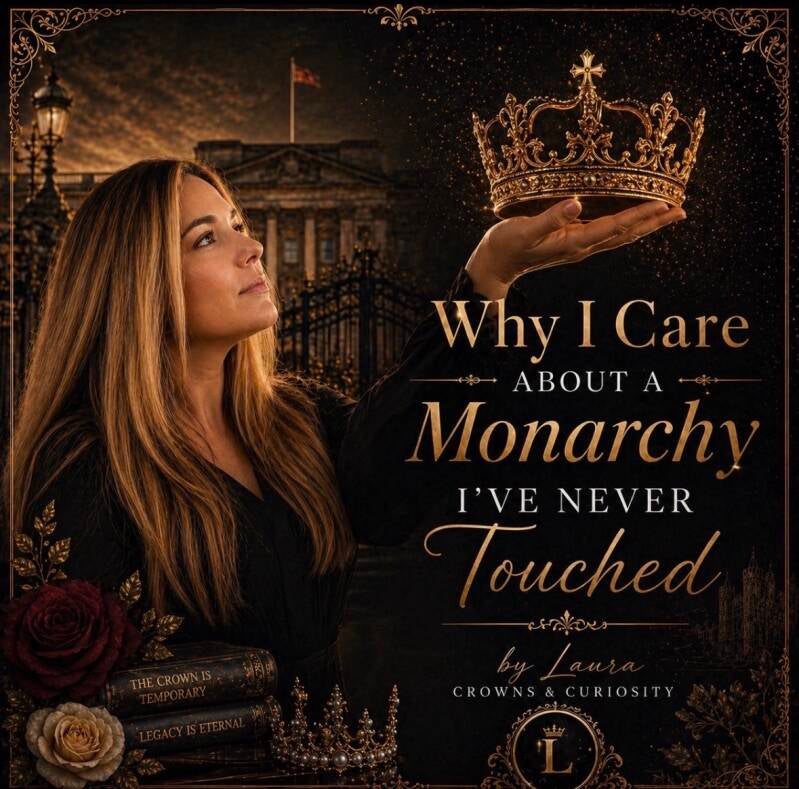
The most common questions I get are "Why are you so obsessed with royalty? Why do you even care?"
To be fair, I have never stood inside a palace. I have never walked the grounds of Windsor, heard the bells of Westminster, or seen the balcony crowds with my own eyes. I am an American woman who has loved something an ocean away for most of my life. I have never even (as of yet) set foot in England. And yet, the monarchy (pretty much all the monarchies, current and historical, but the British monarchy specifically) has always felt strangely close to me—not because I mistake it for perfection, but because it represents something modern life rarely does: continuity, ritual, symbolism, and the enduring power of story. (And to me, that's perfect.)
That may sound dramatic to some people. Fair enough. I am aware that the British monarchy is not my institution. I was not born into it, governed by it, or raised beneath it. I am well aware I am not respectfully required to curtsy. But fascination does not require citizenship, and meaning does not always ask permission from geography. (I will 100% curtsy if given the chance.)
My interest did not begin with constitutional theory or debates over public funding. It began the way many lifelong fascinations do: with imagery, atmosphere, and feeling. The shiny pageantry. The history. The sense that certain places, names, and traditions carried centuries within them. Crowns, castles, ceremonies, portraits, processions—these were not just pretty visuals to me. They were symbols of a world larger and older than the one I knew.
As I grew older, that fascination matured. I learned that monarchy is not a fairy tale. It is human, and therefore flawed. Behind the tiaras and trumpets are families, rivalries, mistakes, grief, ambition, scandals, and contradictions. Royal history is full of brilliance and cruelty, devotion and vanity, duty and disaster. The same institution that can produce dignity can also produce dysfunction. The same family that symbolizes stability can privately struggle like any other.
If anything, learning the truth made the subject more compelling—not less.
Perfection is boring. Humanity is not.
What keeps me interested is not the illusion that monarchy stands above ordinary life. It is the opposite: that something draped in velvet and ceremony is still subject to the same emotions that shape every family and every era. Love, jealousy, insecurity, loyalty, fear, resilience, loss. Change the clothing, update the headlines, and many of the themes remain the same.
That is especially true when viewed through history. I have always been drawn not only to the famous names, but to what they reveal about the societies around them. A queen is never just a queen. She is also a reflection of gender expectations, political pressures, religious conflict, national identity, and the anxieties of her age. A king is never just a king. He is also a mirror for power, succession, ego, and the limits of authority.
This is why I can spend hours reading about the Tudors (and often do), then pivot to modern royal headlines without feeling I have changed subjects at all. The details evolve. The central questions do not. How should power behave? What do people expect from those who inherit privilege? Why do symbols matter so much to the public? Why do we still crave continuity in a world that constantly reinvents itself?
And yes—symbols matter.
We live in an era that often prizes speed over depth, reaction over reflection, novelty over continuity. Everything moves quickly. Everything is updated, replaced, forgotten. In that kind of world, institutions built on memory and ritual can hold a strange emotional power, even for those of us standing outside them. They remind us that not everything meaningful has to be new.
Traditions can be held on to and celebrated for the fact that they are a shared part of the cultural existence, and not everything needs modernization.
Read that again.
That does not mean monarchy should be beyond criticism. Far from it. I do not love it because I think it is flawless. I love studying it because it is layered. Because it can be beautiful and frustrating, dignified and absurd, inspiring and exasperating—sometimes all in the same week. I think I love it more because it is not flawless. Humans will be humans, no matter the headwear.
Perhaps that is why I have never lost interest. The monarchy exists at the crossroads of history and theater, politics and family, symbolism and gossip, grandeur and deeply ordinary human behavior. Where else can statecraft, medieval tradition, sibling rivalry, national mourning, jewels, constitutional restraint, and tabloid chaos all occupy the same story?
And somewhere along the way, that story became part of mine.
It led me to read more deeply. To study more seriously. To write more boldly. To create a space where curiosity could become community. What began as fascination became learning, then voice, then purpose. It gave me a lens through which to explore not only royal lives, but the bigger themes beneath them: identity, legacy, duty, power, womanhood, image, survival.
And my brothers and sisters in Christ, DO NOT come at me with "But the King is just a figurehead." Yes, I understand what a constitutional monarchy is. Do you understand what the royal prerogative is? Leave me alone with all that but call me when there's a State Visit with whoever the Prime Minister is today.
So why do I care about a monarchy I have never touched?
Because distance has never been the same thing as disconnection.
Because history can belong to anyone willing to listen.
Because some stories cross oceans.
And because, somehow, the crown spoke—and I heard it.
Curtsies in American,
Laura
Add comment
Comments