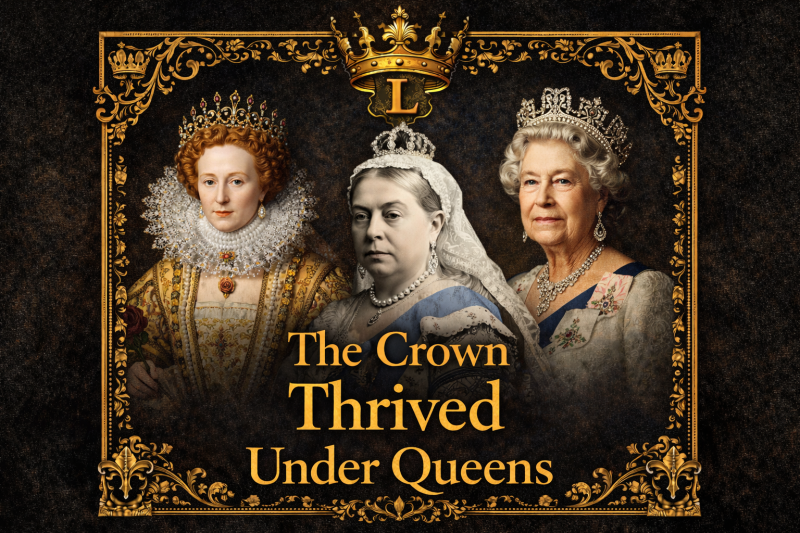
The Crown Thrived Under Queens
History loves its kings. It names eras after them, measures success by their conquests, and treats their reigns as the default against which all others are judged. Queens, by contrast, are often remembered as exceptions – remarkable, but rare. Yet when you step back and look at the reigns that truly stabilized England, expanded its influence, or carried the monarchy through moments of profound change, a different pattern emerges.
Now, I am not a staunch feminist, but I am about to drop this bomb….
Some of the greatest English monarchs were Queens.
And under their rule, the crown did more than survive – it thrived.
I said what I said. Let’s rage.
For the purposes of this narrative, I chose three (of my favorite) Queens of England: Elizabeth I, Queen Victoria, and Elizabeth II.
The Myth of the “Exceptional Queen”
Why isn’t history comfortable with admitting how often England’s most successful reigns belonged to women? Most likely because Queens are framed as abnormalities – figures that succeeded despite the odds stacked against them – rather than rulers with leadership that shaped the crown itself. So history treats them as fortunate accidents – not because queenship could succeed, but because THEY were exceptionally gifted. Elizabeth I becomes the singular genius who defied her sex. Victoria was the unlikely figurehead who presided over an empire almost by coincidence. Elizabeth II was the steady anomaly who endured through sheer temperament. In this framing, queens are praised, but safely isolated. Their success is explained away as an exception, not evidence.
The narrative becomes comfortable because it preserves the idea that kingship is the natural order and queenship is a deviation that happened to work out a few times. (I know…I am twitching at that but its true.) When we examine more closely, that narrative unravels. The reigns of England’s most successful queens were not brief interruptions in the natural order of male tradition; they were long, stabilizing, and institutionally strengthening. These women inherited fractured political landscapes and left behind durable systems – administrative, cultural, and symbolic – that outlasted their lifetimes.
Labeling great queens as exceptions also obscures the structural realities they navigated. Female monarchs ruled under constraints their male counterparts rarely faced: contested legitimacy, intensified scrutiny, and persistent challenges to their authority. That they governed effectively within those limits does not mark them as anomalies – it underscores their political competence. Success achieved under restriction is not accidental; it is instructive.
Perhaps most telling is how quickly the label of “exceptional” dissolves when queens are placed side by side. One queen might be dismissed as a fluke. Three, across centuries, presiding over some of the monarchy’s most consequential periods, cannot be. The problem, then, is not the rarity of capable queens, but the reluctance to recognize queenship itself as a viable and, at times, extraordinarily effective form of rule.
Elizabeth I
(Reigned 1558-1603, 45 years)
Elizabeth I inherited a crown that politically fragile, religiously divided, and widely assumed to be unsuited to female rule. The legitimacy of her reign was questioned from the onset, her authority measured against male standards she could never fully meet, and her marriage status treated as a matter of state urgency rather than personal choice. Yet Elizabeth’s response to those constraints was not to imitate kingship, but to redefine it. Through careful image making, calculated ambiguity, and a disciplined approach to governance, she stabilized England after decades of upheaval and projected royal authority without relying on military conquest or dynastic marriage. Her success was not accidental, nor was it singular; it was the result of deliberate political intelligence exercised within a system that expected her to fail.
What she did well:
-She stabilized a fractured kingdom after decades of religious and dynastic turmoil
-She mastered political image making, using ambiguity as strategy rather than weakness
-She balanced factions at court without allowing any single power base to dominate
-She maintained sovereignty without marriage or foreign dependence
What she did NOT do well:
-Famously avoided naming a successor, creating anxiety late in her reign
-Hesitated to act decisively at times, particularly in matters or internal security
-Relied heavily on trusted advisors, which occasionally delayed necessary action
-Left unresolved tensions that her successor inherited
Why she works for me: What I admire most about Elizabeth I is not the mythology built around her, but the discipline of her rule. She understood that power did not require constant actions to be effective, and that restraint – especially in a court addicted to drama – could be a form of control. Elizabeth’s success feels earned because it was deliberate.
Famous words:
“I know I have the body but of a weak and feeble woman; but I have the heart and stomach of a king.”
Victoria
(Reigned 1837 – 1901, 63 years)
Queen Victoria ascended the throne at a moment when the monarchy’s political authority was already shifting, yet its symbolic power was anything but diminished. Often reduced to a figurehead presiding passively over an empire, Victoria is frequently framed as a monarch who reigned around power rather than wielding it. This reading misunderstands both her role and her impact. Through longevity, moral authority, and carefully cultivated public image, Victoria became the stabilizing constant of a rapidly expanding and increasingly complex Britain. Her reign did not rely on overt political intervention to be effective; instead, it anchored the crown as a unifying institution during a century defined by industrialization, imperial expansion, and profound social change.
What she did well:
-She provided extraordinary continuity during a century of industrial and imperial change
-She anchored the monarchy as a moral and symbolic institution
-She reinforced the crown’s relevance without overstepping constitutional limits
-She became a unifying figure across political shifts and social upheaval
What she did NOT do well:
-Allowed personal grief after Albert’s death to completely withdraw from public life
-At times resisted political reform that reflected the changing public expectations
-Her symbolic power sometimes masked social inequities of the era
-She was not always attuned to the consequences of empire for its subjects
Why she works for me: Victoria’s reign appeals to me because it reframes power as endurance rather than dominance. She ruled long enough to become an institution herself, anchoring the monarchy through change rather than spectacle. That kind of leadership is easy to overlook – and difficult to replicate.
Famous words:
“Great events make me quiet and calm; it is only trifles that irritate my nerves.”
Elizabeth II
(Reigned 1952 – 2022, 70 years)
Elizabeth II inherited a crown facing a different kind of crisis – not instability of succession or expansion of empire, but the slow erosion of deference in a modern, media- saturated world. Often described as passive or ceremonial, her reign is frequently misunderstood as one of endurance rather than leadership. Yet Elizabeth II’s authority lay precisely in her restraint. Through consistency, discipline, and an unwavering commitment to constitutional boundaries, she preserved the monarchy’s legitimacy across decades of political upheaval, cultural transformation, and public scrutiny unprecedented in scale. Her power was not exercised through command, but through continuity – a form of rule uniquely suited to a crown that needed to survive, not dominate.
What she did well:
-She preserved the monarchy through unprecedented media scrutiny
-She understood the power of restraint and consistency
-She maintained political neutrality with near unbroken discipline
-She adapted the crown to modernity without eroding its authority
What she did NOT do well:
-Responded too slowly to moments of public emotional crisis
-Allowed the institution’s silence to be mistaken for indifference
-Was cautious to a fault when confronting internal family scandals
-Relied on tradition even when reform may have strengthened public trust sooner
Why she works for me: Elizabeth II resonates with me because her authority was quiet and intentional. She understood that in a modern monarchy, survival depends less on visibility than on consistency. Her restraint was not passive – it was strategic. And she is my absolute favorite monarch of all time, 10 out of 10.
Famous words:
“Grief is the price we pay for love.”
To Wrap This Up:
Elizabeth I, Victoria, and Elizabeth II ruled in vastly different centuries, under entirely different political conditions, and with very different tools at their disposal. Yet each governed with constraint, scrutiny (so much scrutiny), and expectation in ways their male counterparts rarely faced – and still left the crown stronger than they found it. Their success was not a matter of personalities alone, nor luck, nor timing. It was the result of leadership that understood power as something to be managed, preserved, and sometimes deliberately withheld.
To acknowledge this is not to diminish England’s kings, but it does require abandoning the comfortable idea of the “exceptional queen”.
When women ruled, the crown did not falter. It adapted.
In ENDURED.
And in some of its most consequential moments, it thrived.
:curtsies in American:
Add comment
Comments